AK- 47 Assault Rifle
The weapon was developed for motorized infantry, adopted for service with the Soviet Army in 1949 and designated the AK-47. It was not provided with a bayonet.
Characteristics
Caliber, mm
7.62
Cartridge
7.62x39
Sighting radius, mm
378
Length, overal, mm
870
Barrel Length, mm
415
Magazine capacity, rds
30
Sighting range, m
800
Weight w/empty magazine, g
4300
Weight w/loaded magazine, g
4876
Rate of fire, rds/min
600
Muzzle velocity, m/s
700
Killing range, m
1500
Rifling Grooves
4
Rifled Bore, mm
378
Length, mm:cartridgecartridge casebullet
55.938.726
Practical rate of fire, rds/min:single shotsbursts
40090-100
Weight, g:cartridgecartridge casebulletcharge
16.26.87.951.6
Comparison of the AK-47 and M16
From Wikipedia, the free encyclopedia
Jump to: navigation, search
Weapon
AK-47
M16
Manufacturer
IZhMASh
Colt Firearms
Design year
1947
1957
Weight
3.8 kg(8.4 lb)
3.6 kg(7.9 lb)
Length
87 cm(34in)
99 cm(39in)
Cartridge
7.62 x 39 mm
5.56 x 45 mm
Rate of fire
600 round/min
800 round/min, cyclic
Effective range
365 m(328 yd)
550 m(600 yd)
The two most common assault rifles in the world are the Colt AR-15 (designated the M16 by the United States military) and its variants, and the Avtomat Kalashnikova Model 1947 (AK-47). These two have been compared since the late 1960s as rival models, and so have spawned controversy and comparison.
Contents
[hide]
1 Influence of World War II
2 Origins
3 Conceptual differences
3.1 AK-47
3.2 M16
4 Comparison of characteristics
4.1 Weight and size
4.2 Caliber
4.3 Firing mode
4.4 Reliability
4.5 Accuracy
5 Different philosophies
6 See also
7 References
8 External links
9 Other sources
//
[edit] Influence of World War II
World War II combat experience indicated in the future, the combatant with higher firepower and mobility would be in a better position to successfully attain his goals, which was a shift from the previous doctrine of static wars favoring the defender. Bolt-action rifles and revolvers would become obsolete in the face of semi-automatic and fully automatic weapons, and machine-guns would become lighter and more mobile. In particular, the American M1 Garand Semi-automatic rifle, the Russian SVT-40 self-loading rifle and the German Sturmgewehr 44 assault rifle would revolutionize future infantry weapon designs. Both the USA and the USSR realized the need to adapt their current weaponry to the newly adopted doctrines and tactics, and they took different approaches to the same problem, which resulted in the eventual adoption by both sides of the assault rifle concept.
[edit] Origins
The AK-47 design work was completed shortly after World War II, as can be seen by the origin of its model number (47 representing the year it was first built) and was in service in the Soviet army from the early 1950s. The design was influenced by contemporary and previous weapons such as the FG 42, Sturmgewehr 44, and early Russian attempts to build a lighter, automatic rifle based on the Japanese 6.5 mm Arisaka round, such as the AVS-36 Simonov and early 1916 Avtomat by Fedorov. The AK-47 was adopted as the standard issue Red Army infantry weapon due to its firepower, ease of use, low production costs, and reliability, which fit the Soviet concept of operational art as well as being suited for the new mobile warfare doctrines. The AK-47 was widely supplied or sold to nations allied with the USSR and the blueprints were shared with several friendly nations (the People's Republic of China standing out among these).
After the end of World War II, the United States started looking for a replacement for the M1 Garand and Thompson submachine guns in the different branches of its armed forces. Early experiments with selective fire versions of both the M1 Carbine and the Garand proved disappointing. The .30-06 round was too powerful for controllable full automatic fire and couldn't be carried in sufficient quantities to support the rate of fire, and fighting in Korea suggested the .30 carbine round was underpowered. American weapons designers reached the same conclusion as the Germans and Russians: an intermediate round was necessary. However, senior American commanders insisted the emphasis be placed on powerful and accurate rounds and thus the .308 Winchester was formally adopted as 7.62x51 NATO. It was around this caliber the T44E (derived from the T37, in turn a development of the Garand), later adopted as M14 in 1957, was developed. The first confrontation between the AK-47 and the M14 came in the early part of the Vietnam War. Reports from the field that the rifle had too much recoil for automatic fire convinced the Army to adopt a new rifle with smaller caliber, lower-powered ammunition. This round, the 5.56 x 45 mm had equal muzzle energy to the Soviet 7.62x39 mm used in the AK-47, and was the product of lethality studies performed on goats in the late 1950s and early 1960s showing smaller projectiles at higher velocities were more efficient at creating casualties. It should be noted the designer of the AR-15/M16, Eugene Stoner, got very little positive feedback from the Army about his design. It was only after the USAF adopted the AR-15 the Army became interested in the design. This eventually led to the adoption of the AR-15 as the M16 in 1967.
[edit] Conceptual differences
[edit] AK-47
Main article: AK-47
A Type 2 AK-47, the first machined receiver variation
The AK-47 was designed to use the production methods that were state of the art in the Soviet Union in the late '40s. This implied it more or less used the same methods of construction as the PPSh-41 and PPS-43.The design of an automatic rifle was in the works in Russia before World War II even began. The Avtomat Kalashnikov barrel and bolt were milled out of a steel billet. Its receiver, which was at first milled, was later formed from metal stampings, adding to its durability but also the weight of the rifle. In order to be able to use a steel grade that was easy to machine, the barrel and bore were hard chromed. The stock was simply made out of wood, which was a non-strategic material, and perfectly fit the Soviet manufacturing philosophy, where large plants using untrained labor could manufacture basic weapons cheaply and in very large quantities.
Another feature typical of Soviet assault rifles is the capability of the AK-47 to fire under very adverse conditions. This can be attributed to the bad experience the Soviet Union had during the early stages of WW2, where it lacked proper ammunition production facilities. Thus, until 1943, the Soviet Union was reduced to using some very poor powders in its ammunition, leaving heavy residue in the guns using it. The Soviets also had learned early on, during a major conflict there is little time to train soldiers to keep their weapons clean.
Vietnam war veteran David H. Hackworth recalled,
“
One of the bulldozers uncovered the decomposing body of an enemy soldier, complete with AK-47. I happened to be standing right there, looking down into the hole and pulled the AK out of the bog. "Watch this, guys," I said, "and I'll show you how a real infantry weapon works." I pulled the bolt back and fired 30 rounds — the AK could have been cleaned that day rather than buried in glug for a year or so. That was the kind of weapon our soldiers needed, not the confidence-sapping M16.
”
Over time, AK-47 descendants have been simplified through the use of spot welding and by further reducing the number of machined parts. The Izhevsk factory manufacturing descendants like the AK-101 can produce around 24,000 units a day. Because of its design it is not possible to manufacture the AK-47 series efficiently in small plants, due to large amount of metal stamping equipment needed for mass production. However, the AK-47 has been copied and manufactured in small shops all around the world, at the expense of many more man hours per unit.
[edit] M16
Main article: M16 rifle
An early M16 rifle: note "tulip" flash hider, triangular handguard, and the lack of forward assist, as well as the older-style rear sight assembly
During the later '50s, when Colt bought the blueprints of the AR-15 (M16) from ArmaLite, there had been many improvements in the field of machining equipment, the biggest being the introduction of numerical control machines. While aluminum is not as strong as steel, it is lighter and easier to machine.
The objective was to design a new assault rifle that was easy to carry and manufacture in early automated plants using numerical control machining. It was to use a smaller caliber bullet to allow the soldier to carry more ammunition, which increased his firepower while also enabling him to obtain a higher hit probability. The M16 would achieve all these objectives by using all the latest technologies of its day.
Unlike the AK-47, the M16 concentrated on semi-automatic accuracy rather than on full automatic firepower. The M16's 5.56 mm M193 bullet would sometimes fragment on impact, and thus create wounds that were out of proportion to its caliber. The 7.62x39 mm round of the AK-47 generally does not fragment. "...the 7.62 x 39 is still quite deadly having an unusual tendency to remain intact even after taking unusual deviations upon contact with bone."[1]
Unlike all the other gas operated modern assault rifles, the M16 does not have a separate piston. Rather, it deflects the gases into a small chamber inside the bolt assembly where the rotating bolt acts similar to a piston. This system works well provided clean burning powders are used in the ammunition. The primary advantage of this system is enhanced accuracy when firing full automatic. It also reduces felt recoil to a very low level. The main disadvantage is it allows carbon to accumulate inside the receiver, which mandates cleaning after each use. One early major improvement was to also hard chrome the barrel and chamber, which reduced spent case ejection problems plaguing the very first M16s. Over time, however, many small changes have improved the reliability of the M16. Reliability issues with first production version were worked out later in the Vietnam conflict by re-introducing stick powder into the ammunition, as opposed to ball powder which would swell the cartridge casing and cause jamming. The forward assist was also added to the M16 Army Variant (the Air Force had made the forward assist a condition of acceptance), which allowed for the correction of the situation where the bolt would fail to fully push a cartridge out of the magazine and into the chamber.
A Marine with an M16A4 (equipped with ITL MARS reflex sight and KAC RAS foregrip) in Fallujah, Iraq, December 2004
Post-Vietnam, all branches of the United States Military began tweaking the rifle to perform at its peak accuracy, and with a much greater reliability in adverse conditions. Thus was born the M16A2: it now carried a heavier steel milled barrel and a tighter rifle twist (1:7) to allow the use of a heavier projectile, as the new ammunition would now include the modern SS109 62 grain projectile from Belgium. Full-automatic capability was replaced with a 3-round burst feature, although some specialized forces were equipped with fully automatic M16A2s (also known as the M16A3). The current model is the M16A4, with MIL-STD-1913 rails (also known as Picatinny rails), which allow soldiers to easily attach scopes, red dot sights, and carrying handles. They also accompany a rail system as the fore-grip, produced by Knights Armament Company. The weapons are now capable of being customized to each soldiers preference, making it a Modular Weapons System. There is confusion about the M16A3 having the Picatinny rail like the M16A4, but really the M16A3 only has the fixed sight of the M16A2.
With the evolution of modern CNC (Computer Numerical Control) machinery, the M16 can now be manufactured in micro plants. In the U.S., a number of manufacturers make modern M16 variants and many are indeed micro plant manufacturers. This is possible because of the high degree of automation that can be applied to the machining of the M16 receiver and upper, which are made out of aluminum.
The M16 appeared much later than the AK-47 and thus provided a platform that offered much more development potential than the AK series. Unlike the AK-47, the M16 continues to benefit from every advance in the CNC field, which allows more and more small manufacturers to make M16s and AR-15s (AR-15 is now used as the designation for civilian versions, limited to semi-automatic fire only). While the M16 is made using aluminum and plastics, it can also be made entirely out of machined steel and wood, at the expense of adding some weight. Where the AK-47 relies on huge Soviet-style, state-run factories, the M16 is ideal for market economy production, spread among many manufacturers around the country, this also ensures it would be nearly impossible to disrupt U.S. M16 production in the case of a major conflict.
[edit] Comparison of characteristics
[edit] Weight and size
M16A1 (top) and AKMS (bottom)
The weight of the AK-47 is 3.8 kg (8.4 lb) without the magazine and is 87 cm (34") in length, although the general shape of the rifle and size of the magazine make it more comfortable for some shooters to fire in the prone position. The M16A1 model of the Vietnam era weighs 3.6 kg (7.9 lb approx.) with a 30 round magazine. M16A1 length is 100 cm (39"). The M16's lighter weight made it easy to carry and to aim quickly. The later models of the M16 weighed more than the original with the addition of heavier (and more accurate) barrels and more rugged components. The M16A2, for example, weighs 3.99 kg (8.79 lb) loaded. The AK-47's ergonomics were often considered more comfortable than the M16's, the AK-47's shorter length and folding stock versus fixed or telescopic stock aids in close quarters combat. In addition, the design of the M16's magazine allows for comfortable and stable firing from the prone position.
[edit] Caliber
Difference in damage to flesh targets done by 5.56 mm vs. 7.62 mm cartridges. It is important to note the difference in the scale of the two pictures when making the comparison.
The AK-47 was designed to use the 7.62x39 mm Soviet cartridge, whereas the M16 was designed for the 5.56x45 mm NATO.
A brief comparison between cartridges reveals the higher-velocity American cartridge has a significant edge in long range performance, and the Russian cartridge, with a heavier projectile, has better terminal performance due to its heavier weight.[citation needed] The heavier Russian projectile is also better in circumstances where the bullet has to pass through any material.[citation needed] This can prove important in heavy underbrush (which can deflect the lighter 5.56 mm round) but can cause problems in urban combat, where the 7.62 mm projectile might go through a wall that the 5.56 mm bullet can not penetrate, thus possibly causing civilian casualties.[citation needed] Conversely, this allows the shooter to fire through light wall materials such as drywall and cinder-blocks and into an opponent using them as cover.
The original ammunition for the M16 was M193 ball, a 55-grain (3.5 gram) projectile with a muzzle velocity of 1,000 m/s (3,280 fps). It is often stated this round would "tumble" upon striking a target. At ranges of up to 75 m, the lead-cored round travels fast enough that the force of striking a body will sometimes cause the round to fragment along the cannelure (crimp where the bullet is clamped to the casing) into at least three pieces (front, back, and jacket).
During the 1970s and 1980s the quest for greater accuracy from light machine guns led to the adoption of a heavier, slower, hardened steel cored round, the M855. The heavier 62-grain (4 gram) SS109 projectile used in the later M855 cartridges sacrificed muzzle velocity but increased the effective range and the ability of the projectile to penetrate solid targets.
[edit] Firing mode
The AK-47 and M16A1 both have a switch allowing the operator to select semi-automatic or fully automatic mode. The M16A1's selector is a small switch on the left side of the lower receiver. The first position is safe, followed by semi-automatic, and then fully automatic. The AK-47's is a lever located on the right side of the receiver. The top-most position is safe, the middle is fully automatic, and the bottom is semi-automatic. The M16's selector can be manipulated with the thumb of the hand holding the pistol grip. Beginning with the M16A2 model, the ability to select fully automatic fire was replaced by a three-round burst mode to aid in ammunition conservation and accuracy. Some later derivatives of M16, such as the M16A3 and the M4A1, retain full automatic ability.
[edit] Reliability
An AK-47 over dirt
The AK-47 has always enjoyed a reputation of reliability. It is gas operated, using the gas from the barrel to push a piston attached to the bolt carrier, operating the action. The gas tube is fairly large and is visible above the barrel. The AK-47 is often built with generous clearances, allowing it to function easily in a dirty environment. It is very simple to disassemble and clean, easily maintainable by "a peasant with a flat rock."
One major factor in terms of reliability lies in the design of the AK-47's magazine feed. The top of the magazine is machined from a single steel billet, making it practically impossible to damage the feed lips causing jams or misfeeds. The M16 (and other NATO mags) are sheet steel pressed, resulting in a relatively fragile feed system. This attention to detail reflects the AK-47's combat-based design; in combat, equipment suffers from hard use and gets damaged.
The M16, though, had reliability issues in its initial deployment, but were quickly fixed in new versions. The direct impingement gas system used by the M16 is similar to normal gas operation but with a few differences. Gas from the barrel is used to cycle the action but lacks the piston, so the gas alone impinges upon the bolt carrier. This design allows residue to be blown into the receiver as well as quickly accumulating carbon build-up within the gas port channel, negatively affecting reliability. The original M16 fared poorly in the humid, dirty environment of the Vietnamese jungle, due to a change in propellant not well tested beforehand. Part of the problem was the M16 was billed as self-cleaning, and cleaning kits were not issued. The infamous reliability problems were due to production errors and a conscious decision on the part of the military to use the more powerful "ball powder" ammunition in the cartridges. While ball powder resulted in a higher muzzle velocity, it created much more residue. The weapon itself was designed to fire cartridges with stick powder. When cartridges using stick powder were introduced, the reliability problems faded away.
The problems became the target of a Congressional investigation. The results of the investigation found that:
The M16 was billed as self-cleaning when it was in fact not.
The rifle was issued to troops without cleaning kits or instruction on how to clean the rifle.
The rifle was tested and approved with the use of a Dupont IMR powder that was switched to a ball powder that increased both wear and fouling.
The lack of a chrome liner for the barrel and chamber created a corrosion problem and contributed to brass case swelling and extraction problems.
Lack of a forward assist rendered the rifle inoperable in combat when it jammed.
[edit] Accuracy
How to aim correctly with the M16
The AK-47 is generally considered a less accurate rifle. The relatively heavier recoil of the 7.62x39 cartridge can also be detrimental, requiring more skill and training to adjust to. Even with the lighter recoil and higher velocity of the 5.56x45 mm round, the original M16 and M16A1 did not offer the accuracy achieved with the later M16A2 using the SS109 bullet in semi-automatic mode. The M16 came from the factory capable of 3-4 MOA accuracy, allowing reliable hits on targets at up to 550 meters.[citation needed]
The aperture sights of the later M16A2 are superior to those used on most earlier assault rifles. Using an aperture rear sight and a small hole to center the front sight post, the human eye automatically centers the front sight post, making aiming faster and more consistent. The M16A2's rear sight features two aperture settings. The larger aperture enables faster sighting in poor lighting conditions. The smaller aperture permits more precise aiming for long-distance targets. The AK-47's sights are of a more traditional open style. The rear sight is a simple V-notch in which the front post is to be centered. This requires more concentration to use, as both the front and rear sight must be kept in alignment, and must be placed further away from the eye, or the same 'blurring effect' of the aperture sights will hinder performance.
[edit] Different philosophies
The M16 and the AK-47 design, capabilities, and role on the battlefield were reflections of the different experience and doctrine of the United States and the Soviet Union.
The AK-47 was the result of Soviet combat experience during World War II. Studies of battlefield reports showed most combat occurred within 300 meters, and the winner was usually the side with the most firepower. The bolt-action and semi-automatic rifles used on the Eastern Front were not optimal choices for this kind of combat, and the late-war submachine guns employed to compensate for these shortcomings lacked range and accuracy, leading to compromise designs such as the SKS, and later AK-47, with the AK-47 considered the ultimate answer to these goals. It gave the average soldier a high rate of fire rendering an AK-equipped squad’s firepower equivalent to submachine guns at close range, while also having a sufficiently powerful cartridge to engage moderately distant targets. The AK-47 was never meant to be an accurate rifle beyond 600 meters since in mobile warfare, distances were covered rather quickly. It also had the advantage of not needing particularly experienced soldiers to be effective - it required very little maintenance, and accuracy wasn’t very important which was ideal for the large conscript-based Soviet army. Weight wasn't important either because Soviet doctrine placed an emphasis on the use of armored spearheads in an attack, followed closely by troop transports like the BTR-70 (which later culminated in the IFV concept; see M2 Bradley and BMP-2).
The M16, on the other hand, was influenced by the U.S. Army's preference for an accurate semi-automatic weapon. Although the U.S. Army’s studies into World War II combat accounts came up with very similar results to that of the Soviets', the Army maintained its traditional views and preferred highly accurate weapons. This culminated in the M14. Combat experience in Vietnam showed this was anachronistic. A replacement was needed, a medium between the traditional philosophy of highly accurate semi-automatic rifles and the AK-47. Lighter weight, accuracy and ergonomics were the priority for the American armed forces, and aviation materials were used in its construction, which resulted in higher costs per unit when compared to the simple steel construction of the AK-47. Because American patrols in the thick Vietnamese jungle during the Vietnam War were restricted to foot and later on, helicopter movement, weight was a very important consideration.[citation needed]
NSAS (India, 1988) automatic rifle (Assault rifle)
This automatic rifle is developed from the AK-74. The operating handle is arranged to the left under the fore grip. It can fire single shots and automatic three-shot bursts. The magazine is made from light, transparent plastic material. The automatic rifle features a diopter sight calibrated from 200 to 400 meters and windage mechanism. The butt, fore grip and pistol are made from wood. The safety selector lever is arranged on the trigger guard, to the left. The barrel is outfilled with recoil compensator. There is a lug on the lower part of the barrel to mount a bayonet.
Characteristics
Caliber, mm
5.56
Cartridge
5.56x45
Sighting radius, mm
470
Length, overal, mm
940
Barrel Length, mm
460
Magazine capacity, rds
20
Sighting range, m
400
Weight w/empty magazine, g
3465
The INSAS is obviously based on AK design with many details inspided by Valmet/Galil. Interesting how dificult it could be to make the "improved design" work at least as good as the original... There are already sevaral more or less sucesfull 5.56x45 NATO caliber designs based on AK, now even original Izhevsk AK's made in that caliber, not to mention selection of other good "ready off the shelf" designs availble. Why waste money on another "ingenious" design which is in fact just slightly different to those already existing?BTW, is the Indian 5.56mm ammo the same size as 5.56x45 NATO?
INSASIndian Small Arms System
Available ImagesImages of the INSAS
Technical Data
Manufacturer
Indian State Ordnance Factory Board
Country Of Origin
India
Date Of Introduction
1958
Caliber
5.56 x 45 mm SS109 Special
Feed System
Magazine
Rate Of Fire
650 rounds per minute
Weights
3.2 kg
Length
960 mm, stock extended
More Information *
NSAS stands for Indian Small Arms System. It is a family of infantry arms consisting of an assault rifle, a light machine gun and a carbine. It is manufactured by the Indian State Ordnance Factory Board at their Ishapore Rifle Factory. Although largely based on the ever popular AK-47 Rifles, the INSAS has a number of differences making it a unique rifle. It has features and design borrowed from the FN FNC, AK-74, the Galil and G3. In assault rifle version it has semi-auto and 3-round burst modes much like the US M16A2 assault rifles. These rifles have been exported to the neighbouring kingdom of Nepal. Although other parties have shown interest, none have yet come forward to purchase these rifles. The INSAS rifle saw combat with Indian soldiers during the 1999 Kargil conflict with Pakistan. Quoting the Times of India newspaper [1], the rifle had some reliability problems in the very cold climate in which that conflict took place, apparently some of these problems with the rifle have been fixed.The INSAS rifle was sold at a very discounted rate to the government of Nepal, and many more given as military aid to combat Maoist insurgency. Some sources claim around 100,000 were exported to Nepal as part of this agreement.
Technical Data
Manufacturer
-
Country Of Origin
Soviet Union, Russia
Date Of Introduction
1951
Caliber
7.62 mm x 39mm
Feed System
Magazine or Drum
Rate Of Fire
600 rounds per minute
Weights
4.3 kg
Length
870 mm
More Information *
The AK-47 (Avtomat Kalashnikova 1947 ; Russian: Автомат Калашникова образца 1947 года) is a gas-operated assault rifle designed by Mikhail Kalashnikov, produced by Russian manufacturer IZH, and used in many Eastern bloc nations during the Cold War. It was adopted and standardized in 1947. Compared to the autoloading rifles used in World War II, the AK-47 was generally lighter, more compact, with a shorter range, a smaller 7.62 × 39 mm cartridge, and was capable of selective fire. It was one of the first true assault rifles, and remains the most widely used. The AK-47 and its numerous variants have been produced in greater numbers than any other assault rifle, and it remains in production to this day.
M16M16 & AR-15 Assault Rifles (USA)
Available ImagesVarious pictures of M16 and AR-15 rifles with different configurations.
Technical Data
Manufacturer
ArmaLite
Country Of Origin
United States Of America
Date Of Introduction
1958
Caliber
5.56x45 mm
Feed System
Magazine
Rate Of Fire
800 rounds per minute
Weights
7.5 lbs ( 3.4 kg )
Length
39 in ( 991 mm )
More Information *
The M16 is a lightweight, 5.56 mm caliber, air-cooled, gas-operated, magazine-fed rifle, with a rotating bolt, actuated by direct impingement gas operation. It is constructed of steel, aluminum and composite plastics.There have been three main iterations of the M16. The first was M16 and M16A1 models, fielded in the 1960s that fired a U.S. M193/M196 round that could fire either semi- or fully-automatically. The second was the M16A2, which entered service in the 1980s and fires the Belgian-designed M855/M856 rounds (adopted at that time as the new 5.56 x 45 mm NATO standard round). The M16A2 can fire either semi-automatic or bursts of up to three rounds. Mode of fire is determined by using a selector switch on the side of the weapon. Finally, the M16A4 became standard issue for the United States Marine Corps during Operation Iraqi Freedom, increasingly replacing the earlier M16A2. In the United States Army, a combination of the M16A4 and M4 Carbine continue to replace existing M16A2s. The M16A4 features a handguard with four Picatinny rails for mounting optical sights, laser pointers, night vision, forward handgrips and flashlights
Light machine gun (commonly abbreviated LMG) is a category comprising machine guns that are generally lighter than other machine guns of the same period, and usually designed to be carried by an individual soldier, but sometimes with an assistant. Modern light machine guns are often chambered for smaller calibers than medium machine guns, and are mostly considerably lighter and more compact.
Usually, a light machine gun is intended to act as a support weapon, in that it can generate a greater volume of continuous automatic fire than the usual firearms carried by infantry soldiers, at the cost of greater weight and higher ammunition consumption.
It is possible to fire a light machine gun from the hip or on the move, but usually they are fired from a prone position, especially when using a bipod. Early light machine guns (especially those derived from automatic rifles, such as the M1918 Browning Automatic Rifle) were sometimes magazine-fed. Some LMG's, such as the Russian RPK, are modifications of existing assault rifle designs. Adaptations generally include a larger magazine, heavier barrel to resist overheating, more robust action to support sustained fire, and often a bipod. Modern light machine guns are designed to fire more rounds of a smaller caliber ammunition and as such tend to use a belt of ammunition; this allows them to fire for longer periods of time without the need to reload. Other modern light machine guns, such as the FN MINIMI, are capable of firing from both an ammunition belt or a detachable box-type magazine.
Light machine guns are often used as squad automatic weapons.
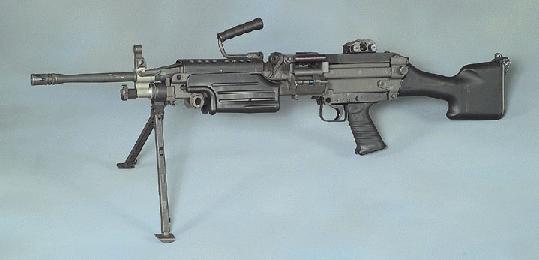
No higher resolution available.M249mg.jpg (539 × 260 pixels, file size: 14 KB, MIME type: image/jpeg)
This is a file from the Wikimedia Commons. The description on its description page there is shown below.
Commons is a freely licensed media file repository. You can help.
Description
English: Machine gun, 5.56mm, M249 Squad Automatic Weapon System (SAWS). The M249 SAWS light machine gun is gas-operated, magazine or disintegrating metallic link-belt fed, individually portable machine gun capable of delivering a large volume of effective fire to support infantry squad operations. The M249 fires the improved NATO Standard SS 109 type 5.56mm ammunition. The M249 replaces the two automatic M16A1 rifles in the rifle squad on a one-for-one basis in all infantry type units and in other units requiring high firepower. The Belgian Fabrique Nationale XM249 "Minimi" was standardized as the M249 Squad Automatic Weapon System in 1982. The M249 filled the void created by the retirement of the M1918A2 Browning Automatic Rifle (BAR) during the 1950s because interim automatic weapons (M14 series/M16A1 rifles) had failed as viable "base of fire" weapons.
Polski: Karabin maszynowy M249SAW, amerykańska wersja FN Minimi
Svenska: En amerikansk version av Ksp 90.
Light Weapons
FN 35 and Glock 17 9 mm pistols
Heckler & Koch MP5 replacing the Carbine 1A 9 mm sub-machine guns
INSAS 5.56 mm assault rifles replacing the FN FAL, 1A1, 1C, AKM and V.58 7.62 mm assault rifles
INSAS 5.56 mm light machine guns replacing the 7.62 mm FN MAG, Bren L4 and the .50 cal Browning M2HB machine guns
Dragunov, Mauser SP66 and Heckler & Koch MSG-90 7.62 mm sniper rifles
AGS-17 Plamya 30 mm automatic grenade launcher
M40 RCL 106 mm and Carl Gustav 84 mm recoiless rifles
Igla-19K310 / SA-16 Gimlet replacing the Strela-2M /SA-7b Grail - portable SAM
Combat vehicles
T-90S Bhishma - main battle tanks (310+) over 1000 T-90S to be manufactured in India
Arjun Mk1 - main battle tanks (125) - the Arjun might be converted into a 155 mm self-propelled howitzer by fitting the South African T6 turret which has the G5 howitzer fitted.
Upgraded T-72M1 Ajeya - main battle tanks (1,900+)
Vijayanta (1,200) and T-55 (700) main battle tanks being phased out
PT-76 (amphibious) and AMX-13 light tanks
Ferret armoured cars
BRDM-2 amphibious reconnaissance vehicles
BMP-1 (700) and BMP-2 (900+)Sarath - mechanised infantry combat vehicles relegated the OT-62/64 to mortar carriers.
Artillery
Agni medium-range ballistic missiles that can attack China and Pakistan and beyond.
SS-150/Prithvi-1 and SS-250/Prithvi-III - short-range ballistic missiles
Smerch 9K58 - 300 mm multiple rocket launch system
Pinaka - 214 mm multiple rocket launch system replacing the 122 mm BM-21
Abbot (105 mm) and M-46 Catapult (130 mm) to be replaced by 4000 new 155 mm self-propelled howitzers. On the short list is the Denel LIW T6 turreted Arjun and the Celsius (Bofors) FH-77AD
Bofors FH-77B, upgraded Soltam M-46 155 mm towed howitzers
Soltam M-46 130 mm field guns replacing the 105 mm IFG Mk1/2/3
D-30 122 mm towed howitzers
Tunguska M1 - low level air defense system
Upgraded ZSU-23-4M Shilka self-propelled air defence guns (48)
Upgraded Bofors L40/70 40 mm AA guns replacing the L40/60
ZSU-23-2 twin 23 mm AA guns
Due to delays in the Akash missile program the ZRK-SD Kvadrat / SA-6a Gainful air defence systems is being upgraded (100)
Due to delays in the Trshul missile program the OSA-AKM / SA-8b Gecko air defence systems is being upgraded (50)
S-300V / SA-10 Grumble
Strela-10M3 / SA-13 Gopher - short-range, low altitude SAM
Non-combat vehicles
Bridge Layer Tank using a T-72 chassis and Kartik Armoured Bridgelayer on a Vijayanta chassis - armoured vehicle-launched bridges
Multi-Hop and Extended Span Assault Bridges on T-72 chassis
Sarvatra - 8x8 truck-mounted briging system
VT-72B ARV (200+) and WZT-3 ARV (124, 228 to be delivered by 2007) - armoured recovery vehicle replacing the Vijayanta ARV
BMP-2 Armoured Amphibious Dozer and Engineer Reconnaissance Vehicle (ERV)
Casspir - mine protected vehicles (165)
Tata LPTA 1621 TC - 6x6 truck
Mahindra - light multi-role 4x4
Rampar - amphibious 4x4
Aircraft
Dornier Do 228-101 - light transport aircraft HAL Dhruv multi-role helicopter replacing the HAL Chetak / Allouette II, Cheetah / SA 315B Lama and Lancer
Missiles
Agni 1, 2 and 3 — intermediate ballistic missile BrahMos — supersonic cruise missile Prithvi 1 and 3 (Prithvi 2 with the IAF) — short-range ballistic missile Aakash — surface to air missile Astra — air to air missile
Modern handgun bullets.
AP - Armor Piercing
1 - metal jacket
2 - lead
3 - hardened steel core
back
FMJ - standart hardball bullet
1 - metal jacket
2 - lead core
Main bullet type, and only one accepted for "official" warfare by international agreements
back
JSP - Jacketed Soft Point
1 - metal jacket
2 - lead core
Semi-jacketed bullet with exposed lead at bullets' nose. Has bigger stopping power than FMJ
back
JHP - Jacketed Hollow Point
1 - metal jacketd
2 - lead
3 - expansive hole
Semi-jacketed expansive bullet. In some military handguns may cause jams.
back
Hydrashock - commercial JHP bullet with central rod to achieve better expansion on impact
1 - metal jacket
2 - lead
3 - expansive hole
4 - steel core
back
Lead WadCutter - Target bullet
back
Lead SemiWadCutter - Target bullet
Same as WadCutter, but with sligthly improved ballistic.
back
Lead RoundNose
back
GLASER SAFETY SLUG -
1 - metal tip
2 - metal jacket
3 - shot load
Typical .38sp Glaser is filled with ~30 pieces of #6 shot or ~200 pieces of #12 shot
back
THV - "Tres Haute Vitesse" - "Very High Speed" (French)
Light high-speed core-less bullet with high stopping power
back
SJ ESC - Semi-Jacketed Exposed Steel Core
Light Armour-piercing bullet with hardened steel core. Bullet has alluminium jacket that covers all except the head of bullet. Designed in Russia for 9mm cartridges such as 9x18mm Makarov PBM and 9x21mm SP-10. This bullet, fired from Makarov, is capable to penetrate standart army issue armor vest at 30 meters. When loaded in more powerful 9x19 or 9x21 cartridges, this bullet shows even more potential.
Choosing your ammo is as important as choosing your weapon. Choose wisely, these descriptions should help.
The following basic ammo types are listed in order of armor penetration, best to worst.
AP - Armor Piercing - A hard bullet made from steel or tungsten alloys in a pointed shape typically covered by a thin layer of lead and/or a copper/brass jacket. The lead and jacket are intended to prevent barrel wear from the hard core materials. For gameplay purposes, AP is slightly worse on unarmored targets than FMJ. This is to indicate the hard AP projectiles' tendency not to deform or reliably tumble/yaw.
FMJ - Full Metal Jacket - Made with a lead core surrounded by a full covering of brass, copper, or mild steel. These have very little deformation or expansion, but will occasionally yaw/tumble. FMJ is a good choice when you don't know what you will be fighting or possibly if you will be going up against a mix of armor types.
JSP - Jacketed Soft Point - In the late 1800s, the Indian Army arsenal at Dum Dum, near Calcutta, developed a variation of the FMJ design where the jacket did not cover the nose of the bullet. The soft lead nose was found to still expand in flesh while the remaining jacket still prevented lead fouling in the barrel. For gameplay purposes, JSP is roughly splitting the difference between FMJ and JHP. It gives more penetration than JHP but has more stopping power than the FMJ.
JHP - Jacketed Hollow Point - Soon after the invention of the JSP, Woolwich Arsenal in Great Britain experimented with this design even further by forming a hole or cavity in the nose of the bullet while keeping most of the exterior profile intact. These bullets could theoretically deform even faster and expand to a larger diameter than the JSP. Best used against unarmored targets only, the JHP also has the least over penetration so it is ideal for use around hostages.
Glaser Safety Slug - The Glaser Safety Slug dates back to the early '70s. The inventor Col. Jack Cannon named it for his friend Armin Glaser. Over the years, the projectiles have evolved from crude, hand-produced examples to mass-production; however, the basic concept has remained the same: copper jackets filled with bird shot and cover by a crimped polymer endcap. Upon impact with flesh, the projectile fragments, with the birdshot spreading like a minature shotgun pattern.
The standard 'Blue' Glaser uses a rather fine birdshot which only gives 5 to 6" of penetration in flesh. The 'Silver' Glaser adds another 1 to 2" of penetration with the use of slightly larger birdshot. Due to the much reduced penetration in flesh, some have theorized that the Glaser would be ideal where over-penetration of a projectile could be hazardous to bystanders. For instance, the Glaser may be stopped by a muscular or upraised arm. However, for the same reasons, the Glaser’s terminal performance can vary dramaticly, producing impressive successes and equally spectacular failures depending on the angle at which the target is struck.
Glancing hits on hard surfaces will result in fragmentation, reducing the risk of ricochets. However, the Glaser can penetrate barriers such as drywall, plywood, and thin sheet metal if struck directly. The Blue and Silver Glaser handgun loads are worthless against body armor, penetrating only 5 layers of Kevlar.
Training Ammo - The training ammo is portrayed as a cross between the FX paint cartridges like Simunitions and long range simulators like the laser-based MILES. It is intended more for clan practice, and is not suitable for single player usage. It can cause wounds, however.
The Hague Accords - The Hague Accords ban the use of expanding projectiles against the military forces of other nations. Some countries accept this as a blanket ban against the use of expanding projectiles against anyone, while the U.S. feels free to use JSP and HP against terrorists and criminals. (The U.S. didn't sign the complete Hague Accords in any case, but still follows its guidelines in military conflicts.)
12 gauge/70mm Shotgun ammo
The trick with the buckshot is that you can have a few large pellets or a bunch of smaller pellets. The smaller pellets have a better chance of scoring a hit due to the sheer number of pellets, but the severity of the wound won't be as great as a hit from a larger pellet. The same principle applies to the armor piercing QB-8 (Quadrangle Buck) and flechettes. For purposes of game play, the armor piercing shot will not be as effective as standard buckshot against non-armored targets. (Of course, the standard buckshot is worthless against armored targets except for taking out the legs and arms, hoping for enough wounds to cause incapacitation.) They are listed from largest to smallest, separating the list into non-armor piercing and armor piercing types. The capacities are based on a 70mm length hull.
000 Buck - 8 lead pellets (0.36")
00 Buck - 9 lead pellets (0.33")
0 Buck - 12 lead pellets (0.32")
1 Buck - 16 lead pellets (0.30")
4 Buck - 27 lead pellets (0.24")
QB 8 - 8 pellets (Armor Piercing) - Quadrangle Buck is made from a steel cylinder cut into two layers of four pie-shaped pieces per layer. The numerous sharp edges gives excellent penetration; however, the light weight and poor ballistic shape limits its effective range.
Flechettes - 32 flechettes (Armor Piercing) - Flechettes are essentially small steel nails with tiny fins swaged into the rear.
Slug - Slugs will pretty well flatten any target, armored or not; however, the issue of over penetration will determine whether you want to take the solid or the hollow-point slug.
Slug HP - Hollow-point slugs. Less penetration than regular slugs.
Baton - Rubber batons. Used for training.
Calibers
These ammo types are listed numerically.
.30 US Carbine - In 1940, the US Army's Ordnance Department approached Winchester with a light rifle concept. This was to bridge the difference between the .45 ACP and the .30-06. For the cartridge, Winchester recommended a rimless version of their .32 Winchester Self-Loading sized down for .308" projectiles. The resulting cartridge tossed a 110gr projectile at nearly 2000fps from a carbine-length barrel. While derided for lacking stopping power in contrast to the .30-06, the .30 Carbine is more powerful than many common handgun cartridges of similiar size such as the .357 Magnum.
.300 Whisper subsonic - Made by necking-up the .221 Remington Fireball case to .308" and using a 240gr Sierra MatchKing, this cartridge will fit and feed from 5.56x45mm NATO magazines. The Whisper is subsonic with about as much power and weight as .45 ACP, but in a thinner bullet which dramatically increases armor penetration. Good against all targets, but is unreliable against heavy armor.
.300 Winchester Magnum - A long range sniping round, it is favored by US Navy SEALS and the German Bundeswehr. While not in the same class as the .338 Lapua, it has roughly the same power as 7mm Remington Magnum, and easily exceeds the performance of 7.62x51mm NATO. Good against all targets.
.338 Lapua Magnum - Originally designed as a long range sniping cartridge to bridge the ballistic gap between the .300 Winchester Magnum and the .50 BMG. It is in service with GSG9, the British SAS, British Army, Royal Marines, and the Dutch military. An early prototype of the cartridge even saw service with the US Navy SEALs. Good against all targets.
.338 Whisper subsonic - Made by necking-up the 7mm Remington BenchRest case to .338" and using a 300gr Sierra MatchKing, this cartridge will fit and feed from 7.62x51mm NATO magazines. Good against all targets, but is unreliable against heavy armor.
.357 Magnum - Using a lengthened and strengthened version of the .38 Special case, the .357 Magnum was rapidly accepted by hunters and law enforcement. At the time of its introduction, it was claimed to easily pierce the body panels of automobiles and crack engine blocks. While it has less power than .44 Magnum, it compares favorably to the 10x25mm Norma and .45 ACP, but with better armor penetration. Good against unarmored targets.
.357 SIG - Designed to produce .357 Magnum revolver ballistics in a self-loading pistol (automatics), the .357 SIG is roughly a .40 S&W case necked down to .355". Despite the manufacturer's claims, it is not quite as powerful as an actual .357 Magnum, but it exceeds the 9x19mm NATO and falls roughly in-between the .40 S&W and 10x25mm in power. Good against unarmored targets.
.376 Steyr - Roughly a shortened 9.3x64mm Brenneke case necked up for .375" projectiles. The cartridge is loaded to give performance approaching that of the .375 Holland & Holland. More power than required for two-legged predators, even those with armored hides. Good against all targets.
.40 S&W - Roughly a shorter cased version of the 10x25mm Norma, this round is a step up in power from the 9x19mm NATO in similar sized handguns. Good against unarmored targets.
.40 S&W subsonic - Roughly a shorter cased version of the 10x25mm Norma, this round loses about 20% of it's energy when subsonic. This round is a step up in power from the 9x19mm subsonic, and has beaten out the parent 10x25mm subsonic in popularity. Good against unarmored targets.
.44 Magnum - A high powered pistol cartridge designed primarily for hunting, the .44 Magnum offers less power than .50 AE and .454 Casull, but much more than .357 Magnum. Good against unarmored targets.
.440 CorBon Magnum - The .440 CorBon Magnum is derived by necking down a .50 Action Express case down to accept the same .429" projectiles used in .44 Magnum cartridges. The 240gr .429" projectile has equal sectional density to the 325gr .500" of the .50 AE. However, with equal powder charges, the .440 CorBon can launch the 240gr projectile much faster than the 325gr projectile from the .50 AE. This equals greater energy and penetration against hard and soft targets.
.45 ACP +P - The standard U.S. pistol round for about a century, the .45 ACP offers more power than .40 S&W but less than a full-power 10x25mm Norma. The +P designation indicates that the cartridge is loaded to higher pressures and generates higher velocity than normal version of the round. Very effective against unarmored targets while reducing the specter of over-penetration.
.45 ACP subsonic - The standard U.S. pistol round for about a century. Typical .45 ACP loads are already subsonic, making them ideal for suppressed weapons. Good against unarmored targets.
.454 Casull - A very high powered pistol cartridge designed for taking the largest game animals, the .454 offers more power than .44 Magnum and has superior penetration over the .50 AE. It is the most powerful handgun cartridge in NATO 3. Good against armored targets.
.45-70 Government - Adopted by the US Army in 1873 as their standard service rifle cartridge, the .45-70 Government refuses to fade away. Most commercial loadings of the cartridge are constrained by the possibility that someone may attempt to fire a modern loading in one of the 1873-vintage rifles. However, current production rifles from Marlin, Ruger, and Browning can accept pressures nearly twice as high as the original black powder specs. The low velocity of typical .45-70 loads does not lend itself to defeating soft body armor, but the high sectional density of the projectile can result in severe blunt force trauma.
.50 Action Express (AE) - A very high powered pistol cartridge, exceeding the .44 Magnum, the cartridge's combination of high velocity and mass results in very favorable penetration characteristics against hard cover and certain types of body armor. It is excellent in close quarters where the first shot is often the only one that counts.
4.6x30mm H&K - H&K's answer to the 5.7x28mm FN. Based on HK's experimental 4.6x36mm cartridge for the HK36 ACR in the early '70s, even retaining its unique Löffelspitz (spoon-nose) projectile. Like the FN entry, the 4.6x30mm has amazing armor penetration, yet recoils less than a 9x19mm pistol cartridge. The smaller HK projectile appears to gives superior penetration over the FN variant, but this also detracts from the permanent wound cavity. Best against unarmored targets, but can be used against armored.
4.92x34mm H&K caseless - This revolutionary round encases the bullet in a combustible material. There is no brass holding the cartridge together and the "powder" is completely burned upon firing. The round itself is ballisticly similar to the 5.45x39mm Soviet but has better armor penetration. Good against all targets.
5.45x18mm Soviet - Similiar to a necked down 6.35x16mm Browning (.25 ACP) and producing exterior ballistics equal to a .22 rimfire, 5.45x18mm cartridge possesses an impressive ability to defeat body armor. For best gameplay results, one should still restrict its use to unarmored targets only and use multiple shots.
5.45x39mm Soviet - The Soviet's response to the 5.56x45mm NATO cartridge. While the long 5.45mm projectile doesn't fragment like the 5.56x45mm NATO, it is more prone to reliably tumble/yaw. Good against all targets.
5.56mm Steyr Flechette - Introduced for the US Army's ACR trials, the Steyr cartridge uses a plastic case with a small caliber flechette pulled by a 5.56mm diameter sabot. The flechette is launched at a high velocity and the narrow projectile offers excellent penetration. However, this small diameter also reduces the terminal ballistics. Good against all targets but tends to wound more than kill.
5.56x45mm NATO - Adopted by the US military in the 1960s, it later became the NATO standard rifle cartridge in the early '80s, displacing the much more powerful 7.62x51mm. Good against all targets, but has trouble with heavy armor.
5.7x28mm FN - The small high velocity cartridge used in FN's new pistol and SMG appears much like a miniature rifle round. The 5.7mm FN cartridge has amazing armor penetration due to its small projectile size and speed, yet has much less recoil than many pistol rounds. However, don't be tricked into believing that it is as powerful as a rifle cartridge. The ballistics are roughly pistol level with far superior penetration. Best against unarmored targets but can be used against armored.
5.7x28mm FN subsonic - This round loses about 50% of its power due to the dramatic reduction in velocity. While the heavier projectile allows it to retain a portion of its armor penetration, its performance is severely hampered. Use against unarmored targets only and use multiple shots.
7mm Remington Magnum - A long range hunting cartridge, the 7mm Remington Mag has its proponents among the US Secret Service (at least until recently) and those not emotionally tied to a .30" projectile. While less powerful than the.338 Lapua, it offers roughly the same power as .300 Winchester Magnum and far more power than the 7.62x51mm NATO. Good against all targets.
7.62x39mm Soviet - The standard Soviet/ComBloc rifle cartridge from the mid-1940s to the mid-'70s, it is easily one of the most widely distributed cartridges in the world due to the distribution of the ubiquitous AK-47 series. Roughly equal in terminal performance with the 5.56x45mm NATO, it is far powerful less than 7.62x51mm NATO. Good against all targets.
7.62x42mm Soviet - Outwardly similiar to the Nagant revolver cartridge, the 7.62x42mm Soviet's case contains not only propellant and a projectile, but a piston sandwiched between the two. When the propellant is ignited, the expanding gas presses the piston forward to expel the projectile. However, the piston remains trapped inside the case, effectively sealing off the escape of propellant gas. The lack of expelled gas and a subsonic projectile results in no firing signature other than the mechanism of the parent weapon. The 7.62x42mm is credited with a maximum effective range of 50m, and the SP-4 armor-piercing cartridge can only defeat a helmet or body armor out to 25m. For best gameplay results, one should still restrict its use to unarmored targets only and use multiple shots.
7.62x51mm NATO - This was the standard NATO rifle round until it's gradual replacement by the 5.56x45mm. It is much more powerful than 5.56x45mm, but has considerable more recoil. It is now typically restricted to sniper rifles and GPMG. Good against all targets, but with lots of over penetration.
7.62x51mm NATO Duplex - Originally designed to counter human-wave attacks, the M198 Duplex load fires two projectiles for one shot. Good against all targets.
7.62x51mm NATO Match - A variation of the 7.62x51mm NATO, the cartridge uses a heavier projectile such as the 168gr or 175gr Sierra MatchKing. The production methods are tweaked to provide a high level of consistency and quality for the cartridges, which pays off in target group sizes. Good against all targets.
7.62x51mm NATO Sabot - The sabot allows a .224" projectile to be fired from the larger 7.62x51mm case. This is designed to dramatically increase the short range velocity and penetration of the round. Good against all targets. Sabot is an archaic French word referring to a wooden shoe.
7.62x54mmR Russian - The standard Russian rifle round from the 1890s to the mid-1940s, it is now confined to sniper rifles and GPMG. The "R" stands for rimmed. A little less powerful than 7.62x51mm NATO, but the target won't quibble over the difference. Good against all targets.
7.65x17mm Browning - A very small pistol round designed for...very small pistols. However, it was the predominant police service cartridge in Europe until the mid-1970s. It is the weakest of the cartridges in NATO 3 and Rogue Spear. Only useful against unarmored targets, and then only in volume.
7.92x57mm Mauser - The standard German service rifle cartridge from 1888 to 1945, the 7.92x57mm (aka 8mm Mauser) has seen wide distribution around the globe through commercial, surplus, and military sales. Serbia continues to use it in sniper rifles and GPMG. It compares favorably to the 7.62x54mmR Russian and 7.62x51mm NATO. Good against all targets.
9x19mm NATO - Invented for the German military at the turn of the century, the wide distribution of the 9x19mm Parabellum/Luger cartridge made it the logical choice for the NATO standard pistol and SMG round. While weaker than .40 S&W, it tends to have an advantage in weight and capacity. Fairly good against unarmored targets, but very weak against armor.
9x19mm NATO subsonic - As suppressed 9x19mm weapons became more popular, purpose made subsonic cartridges were produced. In order to retain a portion of the energy for both weapon function and terminal ballstics, heavier the normal projectiles were substituted. The US Navy SEALs standardized on a 147gr loading due to its accuracy at 50 meters, allowing for reliable head shots from a suppressed MP5N. This round loses about 20% of it's energy when subsonic. However, many US law enforcement agencies have followed the FBI's advice and now use it as standard issue, even in unsuppressed weapons. The cartridge is weaker than .40 S&W subsonic and is roughly equal to the elderly .38 Special. Fairly good against unarmored targets, very weak against armor.
9x21mm Russian - The 9x21mm Russian cartridge is roughly a lengthened version of the 9x18mm Makarov/PMM. Russian police have realized that the 9x18mm cartridges are barely adequate against criminals wearing body armor and driving sturdy Western European automobiles such as Mercedes-Benz. The armor-piercing RG-054 load is credited with defeating NIJ Threat Level IIIA armor out to 50m. While its muzzle energy is lower than the .40 S&W, it has an advantage in weight and capacity.
9x23mm Winchester - Roughly a 9x19mm case lengthened by 4mm, the 9x23mm Winchester has its roots in IPSC competition shooting. John Ricco of CP Bullets had developed the '9x23mm Super' case as an alternative to the .38 Super ACP, whose cases varied dramaticly in strength. The .38 Super case also has the disadvantage of a vestigial semi-rim, which can interlock in magazines. Not to be confused with the externally similiar 9x23mm Bergmann-Bayard (aka 9mm Largo), Ricco's case could be safely loaded to nearly double the chamber pressure of the older cartridges. Since Olin/Winchester produced the cases for Ricco, they saw the commercial potential for using the case in a loaded cartridge. Unfortunately, Olin/Winchester tried to cut Ricco out of his potential royalties from sale of the new 9x23mm Winchester. The resulting lawsuit (won by Ricco) and the poor marketing of 9x23mm pistols by Colt has led to tepid commercial acceptance. Despite these troubles, the 9x23mm Winchester comes closer to the goal of matching .357 Magnum ballistics than the more popular .357 SIG. Good against unarmored targets.
9x30mm Grom - The 9x30mm Grom (Thunder) is roughly similar in dimensions and performance to the commercially unsuccessful 9mm Winchester Magnum. While its light projectile lacks sectional density, there is more than enough velocity to muscle through armor. It is compariable to the .357 Magnum and .30 US Carbine in similiar length barrels.
9x39mm Soviet subsonic - The 9x39mm Soviet is roughly a 7.62x39mm Soviet case necked up for a heavy 9mm rifle projectile. There are competitive loadings from Nikolai Zabelin and Yuri Folov, each optimized for specific roles. It is compariable in performance to the .338 Whisper, but with slightly less penetration. Good against all targets; however, it can be unreliable against heavy armor.
10x25mm Norma - Originally designed for the ill-fated Bren Ten pistol, the cartridge gained another lease on life when it was briefly promoted by the US FBI. Slightly more powerful than .45 ACP, the narrower projectile offers better penetration and greater effective range. Good against unarmored targets.
10x25mm Norma subsonic - When the FBI's Firearms Training Unit found that full-power 10x25mm loads were too powerful for the average user, the subsonic version was developed. This round loses about 40% of it's power when subsonic. Slightly more powerful than .40 S&W subsonic, the 10x25mm subsonic was briefly the general issue sidearm cartridge of the FBI and continues in use in the FBI's MP5/10 SMGs. Good against unarmored targets.
12.7x99mm BMG (.50 BMG) - Originally designed to pierce tank armor in the First World War, the cartridge still serves an anti-materiel round against light armor. It is basically overkill against personnel. Use this for stopping vehicles.
Sunday, August 17, 2008




SIACHEN POSTING
For many blustery, shivering years, the Indian and Pakistani armies have been fighting a "No-Win" war on the 20,000-foot-high Siachen Glacier, the world's highest battleground. Pakistan, like India, has about 10,000 soldiers camped on this glacier. For a soldier, this is where hell freezes over, a 46-mile river of slow-moving ice surrounded by stupendous towers of snow. Temperatures swoon to 50 below, and sudden blizzards can bury field artillery in minutes. Men sleep in ice caves or igloos and breathe air so spare of oxygen that it sends their hearts into a mad gallop. Fainting spells and pounding headaches are frequent. Frostbite chews its way through digits and limbs. They are prepared, both sides say, to battle on the roof of the world forever.
The Siachen(the place of roses) glacier, 72 km, in the East Karakoram is one of the longest glaciers in the Himalaya and Karakoram. It has number of peaks, side valleys and at its head lies the Indira Col, the divide between South and Central Asia. The Nubra river drains the glacier and ultimately joins the Shyok river near Khalsar. On the west lies the West Karakoram (now under Pakistani control) and towards the east is the Shyok basin, forming the border with China. The northern slopes of the Indira Ridge leads to the Shaksgam valley.
In 1949, after the first of three wars,the nations agreed to a cease-fire line that unfortunately stopped short of the remote massifs of north-central Kashmir -- a disputed area on the map where India, Pakistan and China rub shoulders.The wording in the agreement merely said the line was to continue "north to the glaciers." For two decades, this vague phrasing was of more concern to map makers than soldiers, but then in the 1970s and early eighties Pakistan permitted several mountaineering expeditions to climb high peaks on this glacier. This was to reinforce their claim on the area as these expeditions arrived on the glacier with a permit obtained from the Government of Pakistan. In many cases an liaison officer from the Pakistan army accompanied the team.
Pakistan gave permission to a Japanese expedition to attempt Rimo peak in 1984. This peak is located in the side valley, east of Siachen. It overlooks the eastern areas of the Aksai Chin. Such an expedition would have firmly linked the western routes with the eastern routes, -- the trade route leading to Karakoram Pass and China. The Indian army decided to take action and to prevent such an expedition from proceeding. In April 13, 1984, the Indian Army made a "pre-emptive" move into the glacier to defend the territory and the peaks and passes around it when it launched "Operation Meghdoot". Within weeks, Pakistani forces swept in to oppose them, but the Indians have been able to hold on to the tactical advantage of the high ground. The last major gunbattle in the region was reported September 4, 1999, when India said Pakistani artillery and mortar fire killed nine Indian soldiers on the craggy slopes of Turtuk, near the 47-mile-long Siachen Glacier.
As of date, some 10,000 troops are deployed by Pakistan and a befitting number faces them on the Indian side of the Line of Actual Control. To cater to such a large number of troops, about 6000 tonnes of load is flown into the Siachen Glacier every year. An almost equal amount is para-dropped there. This is achieved by the IAF's AN-32 aircraft and helicopters which serve as a 'lifeline' for the Northern Sector. The Kargil fighting showed India that the most uninhabitable, frozen land was not a sufficient barrier to intrusion. The Indian air force, trying to show that it is on the alert in a region even harder to defend than the sheer Kargil cliffs, has arranged a series of trips for photojournalists to see the Siachen operation. "Particularly since the Kargil war, the load of responsibility of the air force has increased," Air Vice Marshal S.K. Jain told journalists during the tour. "The forces are on alert, ready to meet any threat." The sound of incoming gunfire could be heard as the air force transports loaded up at Leh, on the approach to the Siachen Glacier.
Despite five layers of clothing, paratroopers shiver as they wait to board an air force transport at the world's highest air base at Leh. The AN-32A planes approach the stark runway at Leh in snowy mist, pushed by tail winds. The pilots navigate the steep mountains by sight. Higher on the icy Himalayan peaks, helicopter pilots battle downdrafts as they land on helipads to deliver precious supplies or rescue injured soldiers. The pilots stay on the ground no more than 30 seconds for fear of being shot. But cold kills more troops than bullets. Soldiers brought down to base camp often suffer hearing, eyesight and memory loss because of prolonged use of oxygen masks. Many lose eyes, hands or feet to frostbite. At the glacial heights, where even drinking water is from melting the ice on stoves, bathing is a rarity. Washing of clothing, too, is not possible. Hence, 14 pairs of thermal socks per individual are given for a 90-day stay so that the problem of washing at the posts is eliminated. But soldiers have to wash their clothing before depositing it back and leaving the glacier. Clothing used in the glacier is washed at the hot water sulphur springs on the banks of the Nubra at Panamik, a village near the base camp. Such is the rotation schedule that the washing goes on round the year. A serving Captain, just back from his glacier tenure, describes Panamik as the "world's biggest and highest dhobi ghat".
Some army posts on the peaks are only 1,000 feet from Pakistani entrenchments. Cheetah helicopters fly in to retrieve wounded or sick soldiers and drop supplies to their comrades, who remain behind on the lonely promontories. The enemy is hard to see in the crags and craters in the vast whiteness -- and harder to hit. Rifles must be thawed repeatedly over kerosene stoves, and machine guns need to be primed with boiling water. At altitudes of 18,000 feet, mortar shells fly unpredictable and extraordinary distances, swerving erratically when met by sledgehammer gusts. While some troops fall to hostile fire, far more perish from avalanches and missteps into crevasses that nature has camouflaged with snow. This is especially so now in springtime, as the sun licks away several feet of ice and opens new underground cracks and seams.
But for all these logistical peculiarities, the Siachen conflict might be thought of as just another low-intensity border war -- were it not being fought between the world's two newest nuclear powers. Their combat over a barren, uninhabited nether world of questionable strategic value is a forbidding symbol of their lingering irreconcilability. "This is like a struggle of two bald men over a comb," said Stephen P. Cohen, an authority on the Indian subcontinent at the Brookings Institution. "Siachen is the epitome of the worst aspects of the relationship. These are two countries that are paired on a road to Oslo or Hiroshima, and at this point they could go either way."
Most of India's many outposts are west of the glacier along the Saltoro Range of the Karakoram Mountains. These pickets are reachable to an enemy only after a strenuous climb and then a frontal assault, a near-hopeless task in such thin air. After 50 strides, even a well-conditioned man is gasping for breath with his muscles in a tremble. Seventeen years of refrigerated combat have brought only 17 years of hardened stalemate. The Pakistanis cannot get up to the glacier; the Indians cannot come down. "Nobody can win, no matter how long we fight," said Maj. Gen. V. S. Budhwar, the Indian commander in Leh, whose region includes Siachen. "But this is our land. It is a portion of our nation-state, and we will not cede it." Occasionally, some vital strategic importance is assigned to the Siachen area, with hypothetical aggressors flooding across mountain highways. More often, the conflict is described as a simple matter of principle. Imagine, people say, how America would respond if the Russians overran even a small, barren chunk of Alaska.
"Siachen is an awful place where you can step on a thin layer of snow and, poof, down you go 200 feet," said Gen. Khalid Mehmood Arif, the retired former vice chief of Pakistan's military. "But no nation ever wants to lose a single inch of territory, so Siachen has psychological and political importance. Its value is in ego and prestige." Arduous to live in, the Siachen area is beautiful to look at. Some of the world's tallest mountains fill the landscape, their snowy tops giving way to rivulets of white that glitter against the black and purple rock. It is a moonscape of mesmerizing pinnacles and ridges and drops. Ice formations rise a mile high. Clouds seem at arm's reach. The Indian base camp is at the very start of the glacier, which gently curves upward like a giant white tongue. Barracks, helipads, supply sheds, satellite dishes, a hospital and Hindu shrines are spread across several acres. It is clear the Indians have been here awhile and are ready to stay. The command post is carpeted. Curtains hang along the windows. "We have the heights," said Brig. P. C. Katoch, who runs the operation. In contrast with the superior vista those heights afford, he said, the Pakistani soldier sees nothing: "He hears a helicopter and shoots. He hears artillery and shoots. It's stupid. He doesn't know where he's shooting."
But being king of the hill is costly. The Pakistanis can resupply most of their posts by road and pack mule. At their forward positions, some as high as 21,000 feet, the Indians must rely on helicopters. The whirlybirds strain against the altitude like oversized bumblebees. Many an airdrop is swallowed by the snow. Both sides deploy about 3,000 soldiers. While the Pakistanis refuse to divulge how much they spend in Siachen, the Indians estimate the cost at about $350,000 to $500,000 a day, said Lieut. Gen. R. K. Sawhney, the army's director general of military intelligence. Transporting kerosene is one major expense. Some Indian soldiers live in igloos made of fiberglass panels. Six soldiers can sleep in jigsaw configurations, crowded into a room the size of a king-size bed. Others live in ice tunnels gouged out with a pickax. Either way, small kerosene stoves are the hearths they huddle around. The hissing competes with the howling of the wind. Black smoke seems to color everything, including a man's spit. The highest perches are occupied by only a handful of soldiers, and sleeping is rarely done at night, for this is the most likely time for the enemy to sneak up. Sentry duty is bleak work. Hot water bottles do not stay hot for long. A relay must be set up to exchange frozen rifles for defrosted ones.
During storms, the heavy snowfall seems as thick as long, white drapery. The wind does pinwheels, and the basics of a hard life gets that much harder. "At my post, you have to use a crawl trench to get to the toilet," said Cpl. Joginder Singh. "When it snows, the trench fills up and you have to stand. The enemy can see you and that's how you die." It is difficult to know how many men have been killed. Some local news reports put casualty totals for both sides in the thousands, but this seems based on conjecture. The Pakistanis do not release such details, and the Indians say they have lost only the 616 soldiers whose names appear on a stone memorial at the base camp. The inscription reads: "Quartered in snow, silent to remain. When the bugle calls, they shall rise and march again."
To this day, Kashmir is the issue that most heats the blood of Indians and Pakistanis. "The roots of the Kashmir problem are very tangled, but as far as the glacier goes, this is simply a matter of Pakistanis sneaking their way into a place that doesn't belong to them," said India's Lieut. Gen. M. L. Chibber, retired, who is central to the Siachen saga. An amiable man who left the army in 1985, General Chibber now follows the guru Sai Baba and speaks easily about the futility of war. In 1978, however, he was a commander with responsibility for Siachen. He was alarmed to learn that the Pakistanis were accompanying mountaineers to the glacier. Just as troubling were maps printed in the West. They showed Siachen as part of Pakistan. By the early 80's, both armies were sending expeditions into the area, and suspicions accumulated like fresh snow. In late 1983, the Indians became convinced the Pakistanis were about to seize the glacier, General Chibber said. This was inferred from intercepted communiqués. If further evidence was needed, he said, it came when India sent procurers to Europe to buy cold-weather gear. They ran into Pakistanis doing the same shopping.
India's "pre-emptive" takeover of Siachen was called Operation Meghdoot after the divine cloud messenger in a Sanskrit play. It soon came to seem a burdensome success. Like over-eager chess players, the Indians had failed to plan several moves ahead. "No one had ever carried out military operations at these altitudes and temperatures, so we figured after the summer ended, we'd have to pull out," General Chibber said. "But with the first snows, we realized it was possible to stay up there all winter. If we left, the Pakistanis would take the glacier and then we'd never get it back." In the conflict's first years, with the armies inexperienced at such a cold war, the number of casualties mounted quickly. Valiant, if foolhardy, assaults were attempted. Frostbite, snow blindness and pulmonary and cerebral edema took a huge toll. Daring raids are now rare, the Pakistanis say, though the Indians often boast of victorious defensive skirmishes, killing three here and a dozen there. Each side makes claims the other vigorously denies.
These days, the blasts of artillery and mortar shells are the war's steady cadence. "We fire at them and they fire at us, but this is not a place where the usual calculations of trajectory and distance apply," said Capt. Hamid Mukhtar, a Pakistani artillery officer. Captain Mukhtar was serving at a forward post at 18,000 feet, near a ridgeline known as the Conway Saddle. "There are crevasses on either side of these paths," he cautioned as he walked. "Step into the wrong place and you will go to meet God beneath the snow." Daily patrolling is necessary, if for no other reason than to tread on a marked trail so it will not disappear. In February, in a typical catastrophe, an avalanche crushed 13 Pakistani soldiers tethered together with rope. A single survivor led the search that later recovered the pristine dead, their bodies preserved as if locked in cold storage. Melting leads to snow slides. The noontime temperature in early spring was 10 below, but the sun was bright enough to rapidly turn an exposed nose the color of a radish. Sweat is a problem because it becomes ice in a soldier's gloves and socks. Frostbite is then quick with its work. Even after a day's exertion, most soldiers have little appetite at these heights. Rations come out of tin cans. Fresh produce is rare. An orange freezes to the hardness of a baseball; a potato cannot be dented with a hammer.
Despite the hardships, both sides report an oversupply of volunteers. Stints in Siachen usually last three months or less. "This is my country's soil, and whether something grows here or not, I would gladly die to protect it," said Cpl. Mohammad Shafique, a Pakistani. Few soldiers know much about the other side's territorial claims, but they seem untroubled by doubt of the enemy's murderous skulduggery. While many people in India and Pakistan hope for rapprochement, others merely heap fresh animosity upon the old. Evil is presumed. General Budhwar, the Indian regional commander, said Pakistanis suffer from a "deformed growth," becoming brainwashed in school "with all the dos and don'ts" of Islamic fundamentalism. "Their very existence depends on being inimical to India," he said. One of his counterparts is Brig. Nusrat Khan Sial, who commands Pakistan's Siachen operation from the city of Skardu. He called the Indians "cowards" whose Hindu beliefs lack reverence for human life. He said he suspects they have used chemical weapons in Siachen, which the Indians vehemently deny. "It will be the Indians, not us, who will trigger this situation up to the level where both sides resort to nuclear weapons," he said.
Over the years, Siachen itself has been the subject of seven "major rounds of talks," said Robert G. Wirsing, a scholar at the University of South Carolina. Under various Governments ruled by various parties, negotiators have agreed that the conflict is futile -- and some have even called it lunatic. But one side or the other has always been too afraid of a double-cross to complete a deal. Domestic politics are also a hitch. Any compromise involving Kashmir looms like a lit fuse, especially to unstable Governments. So the two armies fight on, proud of conquering the elements if not each other. Their doctors have become experts at high-altitude medicine, their helicopter pilots adroit at skirting the cliffs. Solar panels are affixed to some igloos. On the Indian side, a kerosene pipeline is being completed. A ski lift will ferry soldiers across the canyons. A pulley system has begun to hoist supplies up the mountainsides. Bacteria are eating human waste in machines called biodigesters. "We have become specialists at high-altitude fighting -- probably the best in the world," boasted General Sawhney, sounding as self-congratulatory as his Pakistani counterparts. "We can tolerate the harsh elements. We have made livable conditions." They are prepared, both sides say, to battle on the roof of the world forever.
The Siachen(the place of roses) glacier, 72 km, in the East Karakoram is one of the longest glaciers in the Himalaya and Karakoram. It has number of peaks, side valleys and at its head lies the Indira Col, the divide between South and Central Asia. The Nubra river drains the glacier and ultimately joins the Shyok river near Khalsar. On the west lies the West Karakoram (now under Pakistani control) and towards the east is the Shyok basin, forming the border with China. The northern slopes of the Indira Ridge leads to the Shaksgam valley.
In 1949, after the first of three wars,the nations agreed to a cease-fire line that unfortunately stopped short of the remote massifs of north-central Kashmir -- a disputed area on the map where India, Pakistan and China rub shoulders.The wording in the agreement merely said the line was to continue "north to the glaciers." For two decades, this vague phrasing was of more concern to map makers than soldiers, but then in the 1970s and early eighties Pakistan permitted several mountaineering expeditions to climb high peaks on this glacier. This was to reinforce their claim on the area as these expeditions arrived on the glacier with a permit obtained from the Government of Pakistan. In many cases an liaison officer from the Pakistan army accompanied the team.
Pakistan gave permission to a Japanese expedition to attempt Rimo peak in 1984. This peak is located in the side valley, east of Siachen. It overlooks the eastern areas of the Aksai Chin. Such an expedition would have firmly linked the western routes with the eastern routes, -- the trade route leading to Karakoram Pass and China. The Indian army decided to take action and to prevent such an expedition from proceeding. In April 13, 1984, the Indian Army made a "pre-emptive" move into the glacier to defend the territory and the peaks and passes around it when it launched "Operation Meghdoot". Within weeks, Pakistani forces swept in to oppose them, but the Indians have been able to hold on to the tactical advantage of the high ground. The last major gunbattle in the region was reported September 4, 1999, when India said Pakistani artillery and mortar fire killed nine Indian soldiers on the craggy slopes of Turtuk, near the 47-mile-long Siachen Glacier.
As of date, some 10,000 troops are deployed by Pakistan and a befitting number faces them on the Indian side of the Line of Actual Control. To cater to such a large number of troops, about 6000 tonnes of load is flown into the Siachen Glacier every year. An almost equal amount is para-dropped there. This is achieved by the IAF's AN-32 aircraft and helicopters which serve as a 'lifeline' for the Northern Sector. The Kargil fighting showed India that the most uninhabitable, frozen land was not a sufficient barrier to intrusion. The Indian air force, trying to show that it is on the alert in a region even harder to defend than the sheer Kargil cliffs, has arranged a series of trips for photojournalists to see the Siachen operation. "Particularly since the Kargil war, the load of responsibility of the air force has increased," Air Vice Marshal S.K. Jain told journalists during the tour. "The forces are on alert, ready to meet any threat." The sound of incoming gunfire could be heard as the air force transports loaded up at Leh, on the approach to the Siachen Glacier.
Despite five layers of clothing, paratroopers shiver as they wait to board an air force transport at the world's highest air base at Leh. The AN-32A planes approach the stark runway at Leh in snowy mist, pushed by tail winds. The pilots navigate the steep mountains by sight. Higher on the icy Himalayan peaks, helicopter pilots battle downdrafts as they land on helipads to deliver precious supplies or rescue injured soldiers. The pilots stay on the ground no more than 30 seconds for fear of being shot. But cold kills more troops than bullets. Soldiers brought down to base camp often suffer hearing, eyesight and memory loss because of prolonged use of oxygen masks. Many lose eyes, hands or feet to frostbite. At the glacial heights, where even drinking water is from melting the ice on stoves, bathing is a rarity. Washing of clothing, too, is not possible. Hence, 14 pairs of thermal socks per individual are given for a 90-day stay so that the problem of washing at the posts is eliminated. But soldiers have to wash their clothing before depositing it back and leaving the glacier. Clothing used in the glacier is washed at the hot water sulphur springs on the banks of the Nubra at Panamik, a village near the base camp. Such is the rotation schedule that the washing goes on round the year. A serving Captain, just back from his glacier tenure, describes Panamik as the "world's biggest and highest dhobi ghat".
Some army posts on the peaks are only 1,000 feet from Pakistani entrenchments. Cheetah helicopters fly in to retrieve wounded or sick soldiers and drop supplies to their comrades, who remain behind on the lonely promontories. The enemy is hard to see in the crags and craters in the vast whiteness -- and harder to hit. Rifles must be thawed repeatedly over kerosene stoves, and machine guns need to be primed with boiling water. At altitudes of 18,000 feet, mortar shells fly unpredictable and extraordinary distances, swerving erratically when met by sledgehammer gusts. While some troops fall to hostile fire, far more perish from avalanches and missteps into crevasses that nature has camouflaged with snow. This is especially so now in springtime, as the sun licks away several feet of ice and opens new underground cracks and seams.
But for all these logistical peculiarities, the Siachen conflict might be thought of as just another low-intensity border war -- were it not being fought between the world's two newest nuclear powers. Their combat over a barren, uninhabited nether world of questionable strategic value is a forbidding symbol of their lingering irreconcilability. "This is like a struggle of two bald men over a comb," said Stephen P. Cohen, an authority on the Indian subcontinent at the Brookings Institution. "Siachen is the epitome of the worst aspects of the relationship. These are two countries that are paired on a road to Oslo or Hiroshima, and at this point they could go either way."
Most of India's many outposts are west of the glacier along the Saltoro Range of the Karakoram Mountains. These pickets are reachable to an enemy only after a strenuous climb and then a frontal assault, a near-hopeless task in such thin air. After 50 strides, even a well-conditioned man is gasping for breath with his muscles in a tremble. Seventeen years of refrigerated combat have brought only 17 years of hardened stalemate. The Pakistanis cannot get up to the glacier; the Indians cannot come down. "Nobody can win, no matter how long we fight," said Maj. Gen. V. S. Budhwar, the Indian commander in Leh, whose region includes Siachen. "But this is our land. It is a portion of our nation-state, and we will not cede it." Occasionally, some vital strategic importance is assigned to the Siachen area, with hypothetical aggressors flooding across mountain highways. More often, the conflict is described as a simple matter of principle. Imagine, people say, how America would respond if the Russians overran even a small, barren chunk of Alaska.
"Siachen is an awful place where you can step on a thin layer of snow and, poof, down you go 200 feet," said Gen. Khalid Mehmood Arif, the retired former vice chief of Pakistan's military. "But no nation ever wants to lose a single inch of territory, so Siachen has psychological and political importance. Its value is in ego and prestige." Arduous to live in, the Siachen area is beautiful to look at. Some of the world's tallest mountains fill the landscape, their snowy tops giving way to rivulets of white that glitter against the black and purple rock. It is a moonscape of mesmerizing pinnacles and ridges and drops. Ice formations rise a mile high. Clouds seem at arm's reach. The Indian base camp is at the very start of the glacier, which gently curves upward like a giant white tongue. Barracks, helipads, supply sheds, satellite dishes, a hospital and Hindu shrines are spread across several acres. It is clear the Indians have been here awhile and are ready to stay. The command post is carpeted. Curtains hang along the windows. "We have the heights," said Brig. P. C. Katoch, who runs the operation. In contrast with the superior vista those heights afford, he said, the Pakistani soldier sees nothing: "He hears a helicopter and shoots. He hears artillery and shoots. It's stupid. He doesn't know where he's shooting."
But being king of the hill is costly. The Pakistanis can resupply most of their posts by road and pack mule. At their forward positions, some as high as 21,000 feet, the Indians must rely on helicopters. The whirlybirds strain against the altitude like oversized bumblebees. Many an airdrop is swallowed by the snow. Both sides deploy about 3,000 soldiers. While the Pakistanis refuse to divulge how much they spend in Siachen, the Indians estimate the cost at about $350,000 to $500,000 a day, said Lieut. Gen. R. K. Sawhney, the army's director general of military intelligence. Transporting kerosene is one major expense. Some Indian soldiers live in igloos made of fiberglass panels. Six soldiers can sleep in jigsaw configurations, crowded into a room the size of a king-size bed. Others live in ice tunnels gouged out with a pickax. Either way, small kerosene stoves are the hearths they huddle around. The hissing competes with the howling of the wind. Black smoke seems to color everything, including a man's spit. The highest perches are occupied by only a handful of soldiers, and sleeping is rarely done at night, for this is the most likely time for the enemy to sneak up. Sentry duty is bleak work. Hot water bottles do not stay hot for long. A relay must be set up to exchange frozen rifles for defrosted ones.
During storms, the heavy snowfall seems as thick as long, white drapery. The wind does pinwheels, and the basics of a hard life gets that much harder. "At my post, you have to use a crawl trench to get to the toilet," said Cpl. Joginder Singh. "When it snows, the trench fills up and you have to stand. The enemy can see you and that's how you die." It is difficult to know how many men have been killed. Some local news reports put casualty totals for both sides in the thousands, but this seems based on conjecture. The Pakistanis do not release such details, and the Indians say they have lost only the 616 soldiers whose names appear on a stone memorial at the base camp. The inscription reads: "Quartered in snow, silent to remain. When the bugle calls, they shall rise and march again."
To this day, Kashmir is the issue that most heats the blood of Indians and Pakistanis. "The roots of the Kashmir problem are very tangled, but as far as the glacier goes, this is simply a matter of Pakistanis sneaking their way into a place that doesn't belong to them," said India's Lieut. Gen. M. L. Chibber, retired, who is central to the Siachen saga. An amiable man who left the army in 1985, General Chibber now follows the guru Sai Baba and speaks easily about the futility of war. In 1978, however, he was a commander with responsibility for Siachen. He was alarmed to learn that the Pakistanis were accompanying mountaineers to the glacier. Just as troubling were maps printed in the West. They showed Siachen as part of Pakistan. By the early 80's, both armies were sending expeditions into the area, and suspicions accumulated like fresh snow. In late 1983, the Indians became convinced the Pakistanis were about to seize the glacier, General Chibber said. This was inferred from intercepted communiqués. If further evidence was needed, he said, it came when India sent procurers to Europe to buy cold-weather gear. They ran into Pakistanis doing the same shopping.
India's "pre-emptive" takeover of Siachen was called Operation Meghdoot after the divine cloud messenger in a Sanskrit play. It soon came to seem a burdensome success. Like over-eager chess players, the Indians had failed to plan several moves ahead. "No one had ever carried out military operations at these altitudes and temperatures, so we figured after the summer ended, we'd have to pull out," General Chibber said. "But with the first snows, we realized it was possible to stay up there all winter. If we left, the Pakistanis would take the glacier and then we'd never get it back." In the conflict's first years, with the armies inexperienced at such a cold war, the number of casualties mounted quickly. Valiant, if foolhardy, assaults were attempted. Frostbite, snow blindness and pulmonary and cerebral edema took a huge toll. Daring raids are now rare, the Pakistanis say, though the Indians often boast of victorious defensive skirmishes, killing three here and a dozen there. Each side makes claims the other vigorously denies.
These days, the blasts of artillery and mortar shells are the war's steady cadence. "We fire at them and they fire at us, but this is not a place where the usual calculations of trajectory and distance apply," said Capt. Hamid Mukhtar, a Pakistani artillery officer. Captain Mukhtar was serving at a forward post at 18,000 feet, near a ridgeline known as the Conway Saddle. "There are crevasses on either side of these paths," he cautioned as he walked. "Step into the wrong place and you will go to meet God beneath the snow." Daily patrolling is necessary, if for no other reason than to tread on a marked trail so it will not disappear. In February, in a typical catastrophe, an avalanche crushed 13 Pakistani soldiers tethered together with rope. A single survivor led the search that later recovered the pristine dead, their bodies preserved as if locked in cold storage. Melting leads to snow slides. The noontime temperature in early spring was 10 below, but the sun was bright enough to rapidly turn an exposed nose the color of a radish. Sweat is a problem because it becomes ice in a soldier's gloves and socks. Frostbite is then quick with its work. Even after a day's exertion, most soldiers have little appetite at these heights. Rations come out of tin cans. Fresh produce is rare. An orange freezes to the hardness of a baseball; a potato cannot be dented with a hammer.
Despite the hardships, both sides report an oversupply of volunteers. Stints in Siachen usually last three months or less. "This is my country's soil, and whether something grows here or not, I would gladly die to protect it," said Cpl. Mohammad Shafique, a Pakistani. Few soldiers know much about the other side's territorial claims, but they seem untroubled by doubt of the enemy's murderous skulduggery. While many people in India and Pakistan hope for rapprochement, others merely heap fresh animosity upon the old. Evil is presumed. General Budhwar, the Indian regional commander, said Pakistanis suffer from a "deformed growth," becoming brainwashed in school "with all the dos and don'ts" of Islamic fundamentalism. "Their very existence depends on being inimical to India," he said. One of his counterparts is Brig. Nusrat Khan Sial, who commands Pakistan's Siachen operation from the city of Skardu. He called the Indians "cowards" whose Hindu beliefs lack reverence for human life. He said he suspects they have used chemical weapons in Siachen, which the Indians vehemently deny. "It will be the Indians, not us, who will trigger this situation up to the level where both sides resort to nuclear weapons," he said.
Over the years, Siachen itself has been the subject of seven "major rounds of talks," said Robert G. Wirsing, a scholar at the University of South Carolina. Under various Governments ruled by various parties, negotiators have agreed that the conflict is futile -- and some have even called it lunatic. But one side or the other has always been too afraid of a double-cross to complete a deal. Domestic politics are also a hitch. Any compromise involving Kashmir looms like a lit fuse, especially to unstable Governments. So the two armies fight on, proud of conquering the elements if not each other. Their doctors have become experts at high-altitude medicine, their helicopter pilots adroit at skirting the cliffs. Solar panels are affixed to some igloos. On the Indian side, a kerosene pipeline is being completed. A ski lift will ferry soldiers across the canyons. A pulley system has begun to hoist supplies up the mountainsides. Bacteria are eating human waste in machines called biodigesters. "We have become specialists at high-altitude fighting -- probably the best in the world," boasted General Sawhney, sounding as self-congratulatory as his Pakistani counterparts. "We can tolerate the harsh elements. We have made livable conditions." They are prepared, both sides say, to battle on the roof of the world forever.
Subscribe to:
Posts (Atom)